My friends: I, like most of you, am a fan of fine photography. As such a supporter of the arts, I urge you all to check out Rachel Thurston Photography.
Not only is her photography great--she also knows that Seattle is awesome. In conclusion, take a look. You'll enjoy.
29 January 2010


09 January 2010
Chewing exotic

I recently acquired this pack of Eclipse Breeze: Exotic Berry gum. I got it for quite a steal: the friend I went to see Avatar with offered me the rest of her pack for just one piece of my Original Flavor Trident that had been sitting in my pocket for several hours. For those of you who are counting, that's six pieces of foil-and-plastic-wrapped gum (only ONE of which had
 already been chewed) for one piece of paper-wrapped gum. That had been hanging out in my pocket. Her reason for this shrewd deal? It was the worst gum ever. I told her I'd take the remainder of the pack and decide for myself.
The peculiar thing about this Breeze line of Eclipse gum (which also includes Exotic Mint) is that it uses cardamom as an active ingredient and a central flavor. Cardamom is a seed-based herb that generally plays a major role in Indian and other Eastern foods. You can buy it ground on the spice aisle of your grocery store and it often makes a nice compliment to both sweet and savory dishes (I have a recipe for some whole-grain pancakes that calls for cardamom--it plays well with the hint of cinnamon and the nutty whole-wheat and buckwheat flavors). Cardamom seeds are actually sometimes chewed like gum, and are known to freshen breath. The idea to include cardamom in gum is not bad in and of itself.
Where Wrigley went wrong in this particular venture was its attempt to wed the unique taste of cardamom with a totally incompatible berry flavor. Cardamom in my pancakes, or in sweet Scandinavian breads or savory Indian dishes, is carefully balanced against other complimentary flavors. Not so in Eclipse Breeze Exotic Berry. It's like someone just decided to take some berry gum and add in some cardamom to "neutralize the toughest breath odors," then threw the word "exotic" into the name of the gum by way of explanation or apology. Noting that the berry is exotic does not excuse it from sucking.
And yeah, it's probably the worst gum ever.
02 September 2009
Bison riding...?
I just wanted to mention--I think it is strange how many hits I get on this page based off of people clicking on Google results for searches on "bison riding." Do people actually ride bison for sport and recreation?
The latest such hit occurred early this morning at 4:19 am. The user doing the search was in Muttenz, Switzerland. Perhaps the Swiss view bison riding as a typical American hobby?
The latest such hit occurred early this morning at 4:19 am. The user doing the search was in Muttenz, Switzerland. Perhaps the Swiss view bison riding as a typical American hobby?

01 September 2009
Kitchen fail

Alton Brown has never lied to me before. So when I watched the episode of Good Eats about milk, and he told me that homemade cottage cheese is way better than the store-bought stuff, I believed him.
It wasn't much of a stretch of the imagination to believe it for me, actually. See, I don't really like cottage cheese. I like the idea of it--low-fat, high-protein, slightly salty cheese product. I like cheese, I like salt, and protein helps me to live. It should all add up, right? But the actual placing of spoonfuls of cottage cheese in my mouth never really lives up to the ideal.
So when Alton Brown promised a better product that I could make in the comfort of my own kitchen, I decided to jump in. I bought a gallon of skim milk and a small bottle of white vinegar. I enhanced my kitchen tool box with a candy/fry thermometer.

I poured the entire gallon in a large saucepan, clipped the thermometer to the side of the pan, and slowly raised the temperature of the milk over medium heat until it reached 120 degrees Fahrenheit. I turned off the flame and poured in three-fourths of a cup of vinegar, gave the concoction a stir, and let it sit for 30 minutes. I lined a colander with a flour sack tea towel and strained the whey-vinegar-water solution off of the mass of casein protein. I gathered up the edges of the towel and rinsed the clump of protein under cool running water for three to five minutes, let it drain a bit in the colander, and put it in a bowl.
I sprinkled it with a little kosher salt and poured half a cup of whole milk over it.*
I put a spoonful in my mouth.
I chewed the salty paste.
Yes, p
 aste. That's about what it tasted like. Maybe this is why the stuff from the store is so high in sodium--add enough salt to milk protein paste and it's palatable?
The thing that bugs me the most is that I don't know if I did something wrong, if something out of my control went wrong, or if I just really don't like cottage cheese.
In the end, I still trust Alton. Our joint successes far outshine the tasteless failure that sits leftover in a Gladware container in my refrigerator.

*Alton said to use half-and-half, but come on--I was trying to be healthy here.
05 August 2009
Genius
I just watched this TED.com video.* Elizabeth Gilbert, author of the recent popular b ook Eat, Pray, Love, explains a new way to look at creativity and the creative process. I've embedded the video below, but for those of you who don't have 19 minutes' worth of free time or patience right now, I'll sum it up: Creative types carry the burden of being expected (and expecting themselves) to be creative all the time. Creativity can seem like cutting parts of yourself out, a bit at a time, and being constantly burdened with producing at the cost of personal sacrifice. A better way to understand creative genius, according to Ms. Gilbert, is to appreciate that it comes from an outside source. The Romans referred to creative muses as Genius. These ethereal fairies may not really exist, but maybe another creative force does, and maybe it illuminates humans from time to time, giving us glimpses of the Divine. Reshaping our thinking this way takes the burden off of the writer, the musician, the artist, and gives back some credit where credit is due. This is, I think, a brilliant way to perceive the creative process.
Interestingly, the main point that I caught hold of while Ms. Gilbert was explaining this was not the idea that I need to recognize outer inspiration in my own creative processes, but rather that I need to put more emphasis on the efforts required of me to make that inspiration become something worthwhile. At one point in her speech, after describing what inspiration can be like, she counterbalances it with this statement:
This sentence hit me hard, and I realized that at times I neglect the fact that I have to work hard for what's important to me.
This may sound like I'm being harsh on myself. Or it may sound like I'm an idiot for not realizing that I have to work hard for important things. Please bear with me.
First off--I'm not an idiot. I've been familiar with the Law of the Harvest for quite some time, but I think that I sometimes expect to be able to set the terms of what needs to be sown. In high school I started to exercise in earnest. I remember coming to a decision that it was important for me to be in shape. But I would lift weights and run and do sit-ups and push-ups for maybe two weeks, then go stand in front of the mirror, bare from the waste up, and be totally unimpressed with myself. Where was the definition? Why was I still so soft? I had worked hard--really hard--for two whole weeks, with no visible results. It took several times of starting and stopping before I finally realized what was required of me and got into a long-term exercise routine that yielded a leaner body and more defined muscles.**
Second--I don't think I'm being too harsh. I do recognize that in spite of my occasional shortsightedness there are trends of knowing what's required of me and giving my all to get it done. I knew what it would take to become an Eagle Scout. I prepared for and carried out a hard-working two-year mission, learning Spanish throughout. I completed my B.A. and I'm nearly done with my M.A. Perhaps the key difference is that the things I know I need to put X amount of work into have some semblance of defined parameters. I knew from age 12 what I needed to do to achieve the rank of Eagle--it was outlined in my Scout Handbook. I know how long two years is, how long four years is, what courses I needed to take during those four years, et cetera. But nobody was able to tell me how many weeks of hard exercise it would take to get a line of definition onto my abs, and nobody has ever set out how many drafts I need to rewrite in order to produce a publishable account of my Great Uncle Ronald's sordid life.
The brilliant thing about Ms. Gilbert's speech and what it taught me is that it's nothing really new or novel. As I said, I know the Law of the Harvest. And it's not like every time I write something I just sit down and expect the light of creativity to illuminate my keyboard and stream art onto the screen. One of my favorite posts I've written for this blog is my reflections on seeing Dave Brubeck perform in New York. That post is the result of a writing process that involved some research, the transcription of portions of Ken Burns' documentary, and a few revisions and minor rewrites before I felt satisfied with my work, satisfied that it reflected what I felt and thought when I heard and saw Mr. Brubeck perform.
There's a point to all of this. Maybe I'm learning now that if I want to be satisfied with my paper on the anti-sell-out culture of ska, I need to become more of a mule. The creative spark was there--something inspired me to research a paper asking whether or not ska bands and fans really care about selling out or not. I must admit that it's a pretty cool idea and the foundation for a potentially great paper. But so far I haven't put the work into it that has been required. My biographical piece on my Great Uncle Ronald is pretty good, but I need to sweat and labor and barrel through it awkwardly to make it great and get it published. I eventually learned what it would take to get my body into shape. Maybe now I'm learning what it takes to really write well, and not wait for some brilliant idea to strike me and expect to be able to do it justice with a first draft.
*If you're not familiar with TED, it's worth taking a look at the site. TED (Technology, Entertainment, Design) is a non-profit organization that hosts an annual conference in the name of "ideas worth spreading." The conference consists of several short speeches given by leading writers, business people, scientists, et cetera, all of whom have something, supposedly, worthwhile to share. Some of the talks are definitely better than others. Like I said: worth perusing the site.
**Then I fell through a roof and injured my lower back, ruining that for the rest of the summer. But that's another story...
 ook Eat, Pray, Love, explains a new way to look at creativity and the creative process. I've embedded the video below, but for those of you who don't have 19 minutes' worth of free time or patience right now, I'll sum it up: Creative types carry the burden of being expected (and expecting themselves) to be creative all the time. Creativity can seem like cutting parts of yourself out, a bit at a time, and being constantly burdened with producing at the cost of personal sacrifice. A better way to understand creative genius, according to Ms. Gilbert, is to appreciate that it comes from an outside source. The Romans referred to creative muses as Genius. These ethereal fairies may not really exist, but maybe another creative force does, and maybe it illuminates humans from time to time, giving us glimpses of the Divine. Reshaping our thinking this way takes the burden off of the writer, the musician, the artist, and gives back some credit where credit is due. This is, I think, a brilliant way to perceive the creative process.
Interestingly, the main point that I caught hold of while Ms. Gilbert was explaining this was not the idea that I need to recognize outer inspiration in my own creative processes, but rather that I need to put more emphasis on the efforts required of me to make that inspiration become something worthwhile. At one point in her speech, after describing what inspiration can be like, she counterbalances it with this statement:
I'm a mule, and the way that I have to work is that I have to get up at the same time every day, and sweat and labor and barrel through it really awkwardly.
This sentence hit me hard, and I realized that at times I neglect the fact that I have to work hard for what's important to me.
This may sound like I'm being harsh on myself. Or it may sound like I'm an idiot for not realizing that I have to work hard for important things. Please bear with me.
First off--I'm not an idiot. I've been familiar with the Law of the Harvest for quite some time, but I think that I sometimes expect to be able to set the terms of what needs to be sown. In high school I started to exercise in earnest. I remember coming to a decision that it was important for me to be in shape. But I would lift weights and run and do sit-ups and push-ups for maybe two weeks, then go stand in front of the mirror, bare from the waste up, and be totally unimpressed with myself. Where was the definition? Why was I still so soft? I had worked hard--really hard--for two whole weeks, with no visible results. It took several times of starting and stopping before I finally realized what was required of me and got into a long-term exercise routine that yielded a leaner body and more defined muscles.**
Second--I don't think I'm being too harsh. I do recognize that in spite of my occasional shortsightedness there are trends of knowing what's required of me and giving my all to get it done. I knew what it would take to become an Eagle Scout. I prepared for and carried out a hard-working two-year mission, learning Spanish throughout. I completed my B.A. and I'm nearly done with my M.A. Perhaps the key difference is that the things I know I need to put X amount of work into have some semblance of defined parameters. I knew from age 12 what I needed to do to achieve the rank of Eagle--it was outlined in my Scout Handbook. I know how long two years is, how long four years is, what courses I needed to take during those four years, et cetera. But nobody was able to tell me how many weeks of hard exercise it would take to get a line of definition onto my abs, and nobody has ever set out how many drafts I need to rewrite in order to produce a publishable account of my Great Uncle Ronald's sordid life.
The brilliant thing about Ms. Gilbert's speech and what it taught me is that it's nothing really new or novel. As I said, I know the Law of the Harvest. And it's not like every time I write something I just sit down and expect the light of creativity to illuminate my keyboard and stream art onto the screen. One of my favorite posts I've written for this blog is my reflections on seeing Dave Brubeck perform in New York. That post is the result of a writing process that involved some research, the transcription of portions of Ken Burns' documentary, and a few revisions and minor rewrites before I felt satisfied with my work, satisfied that it reflected what I felt and thought when I heard and saw Mr. Brubeck perform.
There's a point to all of this. Maybe I'm learning now that if I want to be satisfied with my paper on the anti-sell-out culture of ska, I need to become more of a mule. The creative spark was there--something inspired me to research a paper asking whether or not ska bands and fans really care about selling out or not. I must admit that it's a pretty cool idea and the foundation for a potentially great paper. But so far I haven't put the work into it that has been required. My biographical piece on my Great Uncle Ronald is pretty good, but I need to sweat and labor and barrel through it awkwardly to make it great and get it published. I eventually learned what it would take to get my body into shape. Maybe now I'm learning what it takes to really write well, and not wait for some brilliant idea to strike me and expect to be able to do it justice with a first draft.
*If you're not familiar with TED, it's worth taking a look at the site. TED (Technology, Entertainment, Design) is a non-profit organization that hosts an annual conference in the name of "ideas worth spreading." The conference consists of several short speeches given by leading writers, business people, scientists, et cetera, all of whom have something, supposedly, worthwhile to share. Some of the talks are definitely better than others. Like I said: worth perusing the site.
**Then I fell through a roof and injured my lower back, ruining that for the rest of the summer. But that's another story...
18 June 2009
Grilled
So I really enjoyed my dinner tonight. I just had to share. If I'd had some foresight, I would have taken a picture before I supped, but I was hungry. And it was delicious.
I purchased some sockeye salmon* at Whole Foods on Monday and I decided to grill it--it had been a while since I'd stoked the grill fires and it sounded good. I rubbed some foil (shiny side out) with a tiny bit of olive oil and put the fillet on it. Then I rubbed about a tablespoon more of olive oil over the meat, sprinkled it with a pinch of kosher salt, and applied some dried dill (I would love to try this with a couple of sprigs of fresh dill). I topped the fillet with some thin lemon slices, covering the whole surface area. Then I folded up the sides of the foil and nearly wrapped it, leaving a sort of vent open at the top. I didn't want to seal it completely--got to let some of that smoke in to flavor it.
I got that started on the barbecue, the coals piled to one side and the salmon on the other so as to keep direct heat from cooking the bottom too fast. While that sat for about 10-15 minutes in the covered grill, I cut the woody ends off of half a bunch of asparagus and put it in a plastic bag with some olive oil, a splash of champagne vinegar, and some salt and pepper. I tossed the whole thing and brought it down to the grill. The salmon was nearly done, so I closed up the foil tent around it and put it far from the coals, letting it cook the rest of the way in its own heat. I arranged the asparagus stalks directly over the coals and let them cook for a couple of minutes, then rotated them all and let them cook another minute or so.
The whole thing was really delicious and hit the spot. The salmon was not overdone and no one of the seasonings overpowered the others. I'll admit that the asparagus could have used a a little less salt and just a little less vinegar, but overall the seasoning was a winning combination, and it complemented the salmon well.
This evening I am content.
*Here's a little tidbit that I've picked up: beware of fish labeled as "Atlantic salmon." The Atlantic salmon has been fished to near extinction. The breed still exists, but almost exclusively as farmed fish. Due to this, Atlantic salmon will have been raised in crowded, netted-in coastal environments, with diets heavy in antibiotics and waters rich in fish poo. Opting for sockeye or "wild Alaskan" or some other variety will help lower the overall crud content of your fillet. Mercury is still a factor with wild fish, though.
I purchased some sockeye salmon* at Whole Foods on Monday and I decided to grill it--it had been a while since I'd stoked the grill fires and it sounded good. I rubbed some foil (shiny side out) with a tiny bit of olive oil and put the fillet on it. Then I rubbed about a tablespoon more of olive oil over the meat, sprinkled it with a pinch of kosher salt, and applied some dried dill (I would love to try this with a couple of sprigs of fresh dill). I topped the fillet with some thin lemon slices, covering the whole surface area. Then I folded up the sides of the foil and nearly wrapped it, leaving a sort of vent open at the top. I didn't want to seal it completely--got to let some of that smoke in to flavor it.
I got that started on the barbecue, the coals piled to one side and the salmon on the other so as to keep direct heat from cooking the bottom too fast. While that sat for about 10-15 minutes in the covered grill, I cut the woody ends off of half a bunch of asparagus and put it in a plastic bag with some olive oil, a splash of champagne vinegar, and some salt and pepper. I tossed the whole thing and brought it down to the grill. The salmon was nearly done, so I closed up the foil tent around it and put it far from the coals, letting it cook the rest of the way in its own heat. I arranged the asparagus stalks directly over the coals and let them cook for a couple of minutes, then rotated them all and let them cook another minute or so.
The whole thing was really delicious and hit the spot. The salmon was not overdone and no one of the seasonings overpowered the others. I'll admit that the asparagus could have used a a little less salt and just a little less vinegar, but overall the seasoning was a winning combination, and it complemented the salmon well.
This evening I am content.
*Here's a little tidbit that I've picked up: beware of fish labeled as "Atlantic salmon." The Atlantic salmon has been fished to near extinction. The breed still exists, but almost exclusively as farmed fish. Due to this, Atlantic salmon will have been raised in crowded, netted-in coastal environments, with diets heavy in antibiotics and waters rich in fish poo. Opting for sockeye or "wild Alaskan" or some other variety will help lower the overall crud content of your fillet. Mercury is still a factor with wild fish, though.
30 April 2009
Old and cheap
No, this post isn't about your mom (zing!). It's about the chocolate I just ate.
I'm sitting up at my client site waiting for a relatively simple task to be performed that will enable me to finish up my work here in about ten minutes and go back to where I'm supposed to work (and where I have personal email access, incidentally). I ate my lunch, I've been catching up on blog reading... still no movement on the simple task I'm awaiting. I've walked up and down the hallway a couple of times and I keep passing this bowl of Easter candy. Chocolate is one of my few weaknesses, but it's that terribly cheap brand that comes in large coin shapes (for Easter and Halloween) as well as eggs (Easter only). I kept telling myself that cheap chocolate simply isn't worth it, and that held me at bay for the first five hours today.
But I just walked by the bowl again and I couldn't resist the siren song of chocolate any more. I took an egg. I unwrapped it. I ate it. I felt sick. Not only is it cheap chocolate--it's old chocolate. Probably from last Easter. Urgl.
My resolve is renewed.
I'm sitting up at my client site waiting for a relatively simple task to be performed that will enable me to finish up my work here in about ten minutes and go back to where I'm supposed to work (and where I have personal email access, incidentally). I ate my lunch, I've been catching up on blog reading... still no movement on the simple task I'm awaiting. I've walked up and down the hallway a couple of times and I keep passing this bowl of Easter candy. Chocolate is one of my few weaknesses, but it's that terribly cheap brand that comes in large coin shapes (for Easter and Halloween) as well as eggs (Easter only). I kept telling myself that cheap chocolate simply isn't worth it, and that held me at bay for the first five hours today.
But I just walked by the bowl again and I couldn't resist the siren song of chocolate any more. I took an egg. I unwrapped it. I ate it. I felt sick. Not only is it cheap chocolate--it's old chocolate. Probably from last Easter. Urgl.
My resolve is renewed.
08 April 2009
Rush Write 3.23 (on 4.08)
In response to this post:
1. Artists gratify men’s urge for immortality by demonstrating that it is possible. An artist may not necessarily capture my visage in oils, or my deeds in verse, etc. (let alone become famous enough to make his rendering of me known to the world). However. The fact that some Italian lady who once sat for Da Vinci can capture the heart of the world, inspire songs, and cause all to bemusedly wonder about her smirk, that tells me that some of us are immortal. That some of us do live forever. And if it’s possible for some Italian lady, then why not me? Why not all of us?
2. “Joyce” is telling us that Homer’s art (specifically the Iliad and the Odyssey) , and the myriad works of art that it inspired did more to preserve the memory of Troy and the war that brought Greece to it than any formal history ever did. That without Homer’s works, Troy would be insignificant and unremembered. I must agree. What other evidence do we have, aside from ruins that were only discovered and identified centuries after the fact and recognized because we knew what Homer told us?
3. I would say that according to “Joyce,” Homer’s telling of the Trojan War is even more valuable/valid because of its inaccuracies. And here I mostly agree with him. The inaccuracies are, arguably, the artistic license of Homer. The myths that are mixed with the history are the things that enrich us, in “Joyce’s” view. The embellishments of Ulysses’ character are what make us relate to him and treasure his tale. Accuracy may affect a work of art’s value as a history, but since when has historical worth been the ultimate standard of value?
1. Artists gratify men’s urge for immortality by demonstrating that it is possible. An artist may not necessarily capture my visage in oils, or my deeds in verse, etc. (let alone become famous enough to make his rendering of me known to the world). However. The fact that some Italian lady who once sat for Da Vinci can capture the heart of the world, inspire songs, and cause all to bemusedly wonder about her smirk, that tells me that some of us are immortal. That some of us do live forever. And if it’s possible for some Italian lady, then why not me? Why not all of us?
2. “Joyce” is telling us that Homer’s art (specifically the Iliad and the Odyssey) , and the myriad works of art that it inspired did more to preserve the memory of Troy and the war that brought Greece to it than any formal history ever did. That without Homer’s works, Troy would be insignificant and unremembered. I must agree. What other evidence do we have, aside from ruins that were only discovered and identified centuries after the fact and recognized because we knew what Homer told us?
3. I would say that according to “Joyce,” Homer’s telling of the Trojan War is even more valuable/valid because of its inaccuracies. And here I mostly agree with him. The inaccuracies are, arguably, the artistic license of Homer. The myths that are mixed with the history are the things that enrich us, in “Joyce’s” view. The embellishments of Ulysses’ character are what make us relate to him and treasure his tale. Accuracy may affect a work of art’s value as a history, but since when has historical worth been the ultimate standard of value?
30 March 2009
Music of the spheres
 I remember learning about the two Voyager space craft when I was in junior high. Of course by that point they had been hurtling through the cosmos for nigh onto 17 years, but it was news to me. The best part of the earth press kit we put together in case some extraterrestrial intelligent life happened across our little craft was a golden record. The record contains greetings in 55 languages, various naturally occurring sounds from earth, several music tracks, and the recorded brain waves of Ann Druyan*, the last wife of Carl Sagan.
This is all really fascinating, but what caught my attention the most when I recently rediscov
 ered all of this was the list of musical tracks that the world decided to put on the record to represent our people and cultures to the universe. Twenty-three different nations collaborated to choose the 90 minutes of music. Most countries selected various folk songs and classical pieces (Bach was a very popular choice--represented three times (Beethoven is on there twice--every other composer only once)). The United States also chose a classical piece for one of its selections--we collaborated with the U.S.S.R. and France to get "Sacrificial Dance" from Stravinsky's "The Rite of Spring" on the album. But the rest of our selections were more... unique:
- "Johnny B. Goode" by Chuck Berry
- "Melancholy Blues" by Louis Armstrong and his Hot Seven
- "Dark Was the Night, Cold Was the Ground" by Blind Willie Johnson
- "Night Chant," a traditional Navajo chant
We're awesome.
As I was learning all of this, I came across this quotation from writer Darren Wershler-Henry:
Design a faster than light spacecraft and then overtake the Voyager II probe for the sole purpose of replacing the gold LP of the second Brandenburg concerto with a copy of The Rise and Fall of Ziggy Stardust and the Spiders from Mars (from his poem The Tapeworm Foundry: andor the dangerous prevalence of imaginatAlso awesome. I mean, this is probably meant to be more clever or in jest, but it's an interesting idea, right? Like maybe we did earth a disservice by putting so much Bach on there instead of diversifying a bit. Maybe David Bowie's alter-ego is truly stellar, while you kind of have to be from here to get the Brandenburg concerto.ion).

I'm curious to know what music other people would have picked to go on the golden record. Here's the track listing. Thoughts?
*Ann Druyan on recording her brainwaves:
Earlier I had asked Carl if those putative extraterrestrials of a billion years from now could conceivably interpret the brain waves of a meditator. Who knows? A billion years is a long, long time, was his reply. On the chance that it might be possible why don't we give it a try?
Two days after our life-changing phone call, I entered a laboratory at Bellevue Hospital in New York City and was hooked up to a computer that turned all the data from my brain and heart into sound. I had a one-hour mental itinerary of the information I wished to convey. I began by thinking about the history of Earth and the life it sustains. To the best of my abilities I tried to think something of the history of ideas and human social organization. I thought about the predicament that our civilization finds itself in and about the violence and poverty that make this planet a hell for so many of its inhabitants. Toward the end I permitted myself a personal statement of what it was like to fall in love.
08 February 2009
26 January 2009
Snow... snow... snow... snow... SNOW!
So I went out my front door this morning and saw flakes drifting down. Without thinking I said, "Aw, shoot--snow!"
Immediately I realized that 10-year-old Cabeza, if he were here, would be sorely disappointed in what a lame adult I had become. Therefore, I repent of my dread of traffic and ice and embrace the possibility of building a snow man (or maybe a snow toilet (ah, Soutridge)). Let it snow!
Immediately I realized that 10-year-old Cabeza, if he were here, would be sorely disappointed in what a lame adult I had become. Therefore, I repent of my dread of traffic and ice and embrace the possibility of building a snow man (or maybe a snow toilet (ah, Soutridge)). Let it snow!
16 January 2009
Dreams: Soccer and the LOC
I figure I should get this one written down and published before I forget any more of it. A night or two after the Nazi invasion dream where I tasted of young ovine, I dreamed I was leading a group of fellows from the elders quorum in my ward to a "manrichment" activity. We were in DC, and I had a soccer ball. We walked past the Supreme Court and took a turn at the entrance to the Library of Congress. Once inside, we spread out and I gave the ball a good kick. It careened off of walls and bounced through the stacks, landing near another guy from my quorum and barely having time to rest before he sent it flying in another direction. It's funny, because I remember in my dream thinking that we were playing soccer--that there were goals and everything--but it seems like really we were just generally making noise and trying to get the ball to bounce off as many fixtures as possible.
After several minutes of general running around and yelling and chasing the ball, an irate middle-aged lady librarian confronted me at the top of an open staircase and started getting all passive-agressive. "Does this seem like an appropriate activity for the Library of Congress? Hmmmmm?"
Since she was playing it overly cool, I decided I would too. I glanced down at the banister and noticed I had a plate of potato chips and a big bowl of onion dip resting at the top there. I reached down nonchalantly and scooped an extra-big helping of dip onto one chip, then shoved it into my mouth. "Sure." Crunch-munch-smack-smack-smack-smack-smack... "I don't see why not." Another chip, more loud munching.
This had the desired effect of Smug Dream Jared, as the librarian dropped her act and started yelling at all of us to get out of there. Security guards showed up and led us all out. But it was fun while it lasted.
There was a second part of the dream, something about having to pack up and check out of a boarding house, but I really don't remember much of anything about it.
After several minutes of general running around and yelling and chasing the ball, an irate middle-aged lady librarian confronted me at the top of an open staircase and started getting all passive-agressive. "Does this seem like an appropriate activity for the Library of Congress? Hmmmmm?"
Since she was playing it overly cool, I decided I would too. I glanced down at the banister and noticed I had a plate of potato chips and a big bowl of onion dip resting at the top there. I reached down nonchalantly and scooped an extra-big helping of dip onto one chip, then shoved it into my mouth. "Sure." Crunch-munch-smack-smack-smack-smack-smack... "I don't see why not." Another chip, more loud munching.
This had the desired effect of Smug Dream Jared, as the librarian dropped her act and started yelling at all of us to get out of there. Security guards showed up and led us all out. But it was fun while it lasted.
There was a second part of the dream, something about having to pack up and check out of a boarding house, but I really don't remember much of anything about it.
12 January 2009
Dreams: Nazis and Lamb
In the tradition of the Shark's dream-recording blog posts, I share with you two recent excursions into my id:
Island of the Nazis
On the night of 2 January I found myself on a boat approaching an island off the U.S. Pacific coast. The island was fairly covered with trees, but a few hundred feet from the shore where we docked there was a cabin, overlooking the ocean. My brother Scott and I went to the cabin, where we sat and talked for a moment (I don't remember the conversation). I glanced out the open door and noticed people moving up from the shoreline toward us. Nazis ! One of them was dressed like some sort of officer, and the rest were his stormtroopers.
I turned the table I was sitting on onto its side to use as a shield, then pulled a small handgun from my pocket. It was old and I wasn't even sure it if was loaded, but I had no time to check the clip. The Nazis were coming through the door! I put my arm up over the edge of the table to see if I could get a few rounds off, but the trigger was stuck. The officer pulled his Luger and shot me in the wrist. I dropped my pistol. I started to bleed pretty badly, but the Nazi officer didn't seem to care.
"Vhat iz ze radio frequency you are broadcasting on??!" I refused to answer--on principle, really, since I had no idea what he was talking about. This angered the officer, so he put his gun to my head and was getting ready to pull the trigger when Scott blurted out the answer, saving my life. This satisfied the Nazis, and they allowed Scott to right the table and help me lie on top of it while he administered first aid to try and stop the bleeding. I had been trying to apply pressure to my wrist this whole time, but the bleeding wouldn't stop. "I don't think it's really all that bad," Scott said. "It looks like a pretty small wound." I looked and saw that he was right. Then I looked away, looked back, and saw a gaping hole opening into my forearm. A nurse (where did she come from?) came in, looked at my arm, and announced that part of it would need to be amputated immediately. And it was.
Someone else who showed up in the cabin said that my amputated flesh shouldn't be wasted, and proceeded to toss it onto a grill. A few minutes later it was done, but the cook decided that he probably shouldn't feed it to anyone, seeing as how that would be cannibalism. But he figured that before he threw it out he should offer me a bite. "Don't you want to know what you taste like?" Turns out that I did. It also turns out I taste like lamb.
Okay, so maybe one is enough for now. I'll post the second dream tonight or tomorrow.
Island of the Nazis
On the night of 2 January I found myself on a boat approaching an island off the U.S. Pacific coast. The island was fairly covered with trees, but a few hundred feet from the shore where we docked there was a cabin, overlooking the ocean. My brother Scott and I went to the cabin, where we sat and talked for a moment (I don't remember the conversation). I glanced out the open door and noticed people moving up from the shoreline toward us. Nazis
 ! One of them was dressed like some sort of officer, and the rest were his stormtroopers.
I turned the table I was sitting on onto its side to use as a shield, then pulled a small handgun from my pocket. It was old and I wasn't even sure it if was loaded, but I had no time to check the clip. The Nazis were coming through the door! I put my arm up over the edge of the table to see if I could get a few rounds off, but the trigger was stuck. The officer pulled his Luger and shot me in the wrist. I dropped my pistol. I started to bleed pretty badly, but the Nazi officer didn't seem to care.
"Vhat iz ze radio frequency you are broadcasting on??!" I refused to answer--on principle, really, since I had no idea what he was talking about. This angered the officer, so he put his gun to my head and was getting ready to pull the trigger when Scott blurted out the answer, saving my life. This satisfied the Nazis, and they allowed Scott to right the table and help me lie on top of it while he administered first aid to try and stop the bleeding. I had been trying to apply pressure to my wrist this whole time, but the bleeding wouldn't stop. "I don't think it's really all that bad," Scott said. "It looks like a pretty small wound." I looked and saw that he was right. Then I looked away, looked back, and saw a gaping hole opening into my forearm. A nurse (where did she come from?) came in, looked at my arm, and announced that part of it would need to be amputated immediately. And it was.
Someone else who showed up in the cabin said that my amputated flesh shouldn't be wasted, and proceeded to toss it onto a grill. A few minutes later it was done, but the cook decided that he probably shouldn't feed it to anyone, seeing as how that would be cannibalism. But he figured that before he threw it out he should offer me a bite. "Don't you want to know what you taste like?" Turns out that I did. It also turns out I taste like lamb.
Okay, so maybe one is enough for now. I'll post the second dream tonight or tomorrow.
11 December 2008
Sweet, sweet freedom
Last night I turned in my last final paper of the semester (huzzah!) and now I stand facing the future. A future of 43 days without obligatory reading. It is time for the annual inter-semester reading spree; here's what's on the list (in no particular order, and not necessarily guaranteed to be read):
Also on the slate for the break: revising my biographical essay on my Great Uncle Ronald that I wrote for a class last semester. Time to get that puppy published. And I need to keep in the habit of writing non-scholarly stuff. Need to keep my focus--it would be a shame to get stuffy at this point.
- The Amazing Adventures of Kavalier and Clay (okay, so this one is in particular order since I'm already reading it--about 150 pages in)
- The Knife Man
- The Devil in the White City
- Assassination Vacation
- The Third Policeman
- The United States of Arugula
Also on the slate for the break: revising my biographical essay on my Great Uncle Ronald that I wrote for a class last semester. Time to get that puppy published. And I need to keep in the habit of writing non-scholarly stuff. Need to keep my focus--it would be a shame to get stuffy at this point.
Peace on earth
In case any of you have forgotten, I've embedded a copy of the best version of "Little Drummer Boy" ever.
Okay, so it's the only good version of "Little Drummer Boy" ever. Still... David Bowie + Bing Crosby = magic.
Okay, so it's the only good version of "Little Drummer Boy" ever. Still... David Bowie + Bing Crosby = magic.
08 December 2008
Feeling scholarly

On Saturday I visited the Library of Congress to--get this--do research. Yes. That's right.
I've been a few times before, but it's generally been for tourism-related reasons. Which are valid enough; it's a beautiful building with great exhibits and other things to see inside. But this is the first time I was there to sit down with rolled-up sleeves and my glasses slowly sliding down my nose while I craned over hard-bound tomes belonging to our nation's official source for congressional research.
So yeah, I felt pretty cool. Here are some highlights of a visit to the LOC, whether for research purposes or otherwise:
- It's like a full-service library. When you know the call number of the book(s) you want, you fill out a slip and hand it to the librarian. In a little while they bring your books to you at the desk you've chosen. And they're all really helpful, friendly, and knowledgeable if you need any help with your research.
- It's full of history. The original LOC burned down in 1814 when a bunch of drunk British Canadians ransacked our capital. As we rebuilt, Thomas Jefferson donated his personal (and quite extensive) book collection to form the foundation of the new library. The builders also decided to stick it to the Brits by making the building better than ever, using the finest materials. Up in the rotunda there were some accoutrements that called for metallic leafing, so they used the rarest and most expensive metal available at the time: aluminum.

- Aluminum leafing aside, it's a beautiful building (as I mentioned before). The inside of the rotunda and all of the vaulted ceilings in the public areas are all covered in mosaic. I love mosaic. More about the art and architecture incorporated into the LOC here.
- People are quiet inside because it's a library. If only people would be quiet in the Lincoln Memorial, seeing as it proclaims itself a temple.
- They've got a Gutenberg Bible in a glass case. So cool.

01 December 2008
Ten feet from legendary

Saturday night, after eight hours in a car, yelling at the non-entity that caused stand-still traffic on the New Jersey Turnpike, navigating an island city that I do not know, and paying profiteer prices for parking, I sat in a dark nightclub ten feet from a piano where Dave Brubeck sat creating. The set started at 8:00 and I finally sat down at 8:15. It took me about two minutes of deep breathing and immersion in music to clear my head. That left me with less than forty minutes of an all-too-short set to enjoy some really, really great jazz. The next morning I went to church with friend Scrumpestuous D, picked up a total stranger, and spent another 8 hours in traffic coming home (read about the homeward trip here). Forty minutes ten feet from Dave Brubeck sandwiched by a total of 16 hours in the car? So worth it.
Dave Brubeck is one of my heroes. He revolutionized jazz in the 1950s with his experiments with time signatures. Up to that point, the vast majority of jazz music was arranged and performed in 4/4. It was simply what was accepted. Then in 1959, Brubeck released Time Out, a daring record that challenged the 4/4 standard. Kathy's Waltz (in 3/4) was an innovation. Even that seemed tame after the album started out with Blue Rondo a la Turk, which shifted back and forth from a frenetic 9/8 to a cool 4/4. The biggest hit off the album--and the biggest hit of Brubeck's career, was Take 5, played in 5/4. He was a musical innovator; he didn't allow himself to be bound by the accepted standards when he composed. He fell back on his classical piano training often and blended its influence into his music.
Before making his musical mark, Brubeck served his country in the army during World War II. Deployed with Patton's Third Army from 1944 to 1945, he was pulled from a unit headed for the front lines because of his musical finesse. Brubeck played piano as the lead of a racially integrated jazz band called the Wolf Pack. They provided entertainment for the troops in an as yet segregated Army. When they returned to the United States at the end of the war, he stayed with his band members for a while, but their mixed group met resistance. Brubeck describes it in Ken Burns' Jazz:
When we landed in Texas, we all went to the dining room to eat, and they wouldn’t serve the black guys. The guys had to go around and stand at the kitchen door. This one guy, he said he wouldn’t eat any of their food, and he started to cry, and he said, 'What I’ve been through, and the first day I’m back in the United States, I can’t even eat with you guys.' He said, 'I wonder why I went through all this.' You know, the first black man that I saw, my dad took me to see on the Sacramento River in California. And he said to his friend, 'Open your shirt for Dave.' There— [crying] there was a brand on his chest. And my dad said, 'These things can’t happen.' That’s why I fought for what I fought for (Jazz, Episode Seven: Dedicated to Chaos).
When he formed his famous quartet that produced Time Out in 1959 and stayed together until 1967, his bassist, Eugene Wright, was black.
I got to ask Mr. Brubeck a question once, in a Q&A at the Kennedy Center in March 2008. I asked him to talk about what it was like to play in an integrated band during a time when the general public resisted the idea of blacks and whites performing together (I may have used the word "pioneer" in there). He talked about the brotherhood and bonds created by music. He emphasized that jazz or no jazz, we're all brothers and sisters, and that was what always mattered to him.
Dave Brubeck is not only a great musician who left an indelible mark on the face of jazz, but he's also a great human being. His forward-thinking attitude and conviction for what was right may not have necessarily broken down racial barriers or overcome a nation's prejudice, but it certainly made a difference in the lives of his fellow Wolf Pack members, or in the life of Eugene Wright.
 And I sat ten feet behind him on Saturday night, watching him create. He continues to meld classical themes into jazz constructs. Despite being 87 years old, he continues to play fluidly and pour an unseen reservoir of energy into his musical performance (his gutteral "aaaahs!" and "haaaaahs!" could be heard throughout the club, punctuated further by a stiff kick into the air under his piano). And he embraces the ideal of jazz as a musical form of freedom. Right before his quartet closed their set with their best-known standard, he stood at the microphone and said, "People ask us all the time if we get tired of playing 'Take Five.' Of course we don't. We've played it every show since 1959, but we never play it the same way. In fact we play it a different way every night. How do you like that?"
I like it even better the way he expressed it in Ken Burns' masterful documentary:
When you get a group of musicians really playing... it was this feeling of freedom, and then a guy would get a solo and this was his expression of freedom. A trumpet player, a trombone, or the saxophones, or the pianos. And then they were completely free, away from the constriction of the written music, but improvising on top of it. And this is the thing I love the most about jazz—it’s the thing that expresses the United States, it expresses freedom. All over the world, jazz is accepted as the music of freedom. It’s the most—it’s more important than baseball!
25 November 2008
Going local: Eastern Market
A week ago Saturday I visited Eastern Market with friend Amanda. Eastern Market is located in the upper-left corner of Southeast Washington, DC, not far from the Capitol. It's easily accessible by rail--it has its own Metro stop on the Blue/Orange line--or by car. Just park on the street in the surrounding neighborhood.
Unlike the other markets reviewed thus far, Eastern Market is open more than just one day a week, and it's much more than a farmers' market. The farmers' portion, plus the arts & crafts and flea markets are open on Saturdays and Sundays (farmers' market: 7 am to 4 pm, arts & crafts and flea markets: 9 am to 6 pm). There's also an indoor area known as the South Hall, open Tuesday through Sunday (Tuesday-Friday: 7 am to 7 pm, Saturday 7 am to 6 pm, Sunday 9 am to 5 pm). There. Logistics out of the way.
Now to the meat of the matter. A visit to Eastern Market, as you may have guessed, is much more than a visit to a farmers' market. If you go there and all you do is buy a sack of apples, you've missed the boat.
 The first thing I do at Eastern Market is enter the South Hall and eat at Market Lunch. In spite of the name, my last visit here was the first time I'd actually ordered a midday meal. Usually I would go in the morning, but this particular Saturday I was looking to fill the afternoon. I ordered the crab cake sandwich with a side of collard greens. The sandwich was very good (not as amazing as the girl in front of us in line would have had me believe), and I liked the collard greens, but I could have used half the portion they gave me. Breakfast is really where Market Lunch shines. I especially recommend the blue bucks (blueberry buckwheat pancakes) or the French toast (paying extra for the pecan topping is a must). The fellow who works the counter is sassy in a way that keeps you coming back, the service is fast, and the prices are more than reasonable. And on any given Saturday morning, you're going to see Mormons standing in line with you. The rest of the South Hall is home to butchers, fishmongers, and bakers who sell high-quality, fresh products.
 Next on my list of stops is Capitol Hill Books. Not technically part of Eastern Market, the used bookstore is located right across the street to the south of the old South Hall (the original brick South Hall building suffered an electrical fire last year; it is currently under renovation and should reopen next summer). Capitol Hill Books is probably the folksiest, most mom-and-pop-type operation I've ever seen. What's more, it pulls it off without feeling forced. I would be surprised if I found out the proprietors ever said, "Hey. Let's figure out how we can be more folksy around here." The ambiance is achieved naturally.
The view from the front window is indicative of the interior as a whole--stacks and stacks of books, not necessarily on shelves (look at the staircase). The store is organized in a patchwork manner, with genres assigned to general areas (fiction, mystery, poetry, and music upstairs; sci-fi and gardening in the basement; nonfiction main level), and subgenres posted on the shelves with helpful notecards. The notecards are spread throughout the store, wherever they might be helpful in your careful search for a particular author or title. "John Gardner on floor behind Hesse." "Gabriel García Márquez located under García." "M-R goes down and across (Arrows may help)."
A friend of mine refers to Capitol Hill Books (really one of her favorite haunts) as "the socialist bookstore;" she's sure that the owners and employees are teetering off the left-hand side of the political spectrum. I couldn't really say; I've never been indoctrinated or even engaged in any kind of political conversation. The gentleman seated at the checkout counter usually just makes humorous and good-natured comments about your purchases. Once he went so far as to quote an entire Yeats poem to Amanda. She melted into a puddle, but she remained a moderate voter.
 Stomach full of blue bucks, newly purchased used books in hand, I then return to the market and pick up produce. The vendors line the sidwalk that runs on the east side of the old South Hall.
  Most of the vendors sell vegetables or fruits, though there is a regular table that offers homemade salsa and dips--both as samples and as packaged wares. The produce is good, nothing notable about the quality, though I did discover a handy feature at one of the vegetable stands during this last visit. The seller packaged small varieties of veggies together into food storage bags and sold them as a bunch for three dollars each. I got a bag with red potatoes, green beans, and a little bit of broccoli. A good deal for what you pay. I also walked further down the line and picked up some Nittany apples (my new fall favorite).
Finally, there are the flea market and the arts and crafts portions of the market. The flea market is located to the south of the temporary South Hall, and it's filled with all sorts of wonders: rugs, trunks, statuettes, jewelry, scarves, handbags, and so on. The arts and crafts booths are set up on the sidewalk opposite the farmers' market sidewalk, and also on the patio north of the old South Hall. Jewelers, potters, painters, photographers, and others show their handiwork. Even if you're not in the market for anything from here, it's always worth it to peruse. Some of the vendors are quite talented--Dan Kessler, whose work has been commissioned by the White House, is there every Saturday.
Eastern Market, as a farmers' market, is not a place I would regularly frequent. The produce is decent, but not spectacular, and the commute into DC takes much longer than a jaunt over to Arlington or a walk to Del Ray. But combining the farmers' market with the prospect of delicious breakfast and used books and local culture adds an allure that keeps me coming back.
Unlike the other markets reviewed thus far, Eastern Market is open more than just one day a week, and it's much more than a farmers' market. The farmers' portion, plus the arts & crafts and flea markets are open on Saturdays and Sundays (farmers' market: 7 am to 4 pm, arts & crafts and flea markets: 9 am to 6 pm). There's also an indoor area known as the South Hall, open Tuesday through Sunday (Tuesday-Friday: 7 am to 7 pm, Saturday 7 am to 6 pm, Sunday 9 am to 5 pm). There. Logistics out of the way.
Now to the meat of the matter. A visit to Eastern Market, as you may have guessed, is much more than a visit to a farmers' market. If you go there and all you do is buy a sack of apples, you've missed the boat.
 The first thing I do at Eastern Market is enter the South Hall and eat at Market Lunch. In spite of the name, my last visit here was the first time I'd actually ordered a midday meal. Usually I would go in the morning, but this particular Saturday I was looking to fill the afternoon. I ordered the crab cake sandwich with a side of collard greens. The sandwich was very good (not as amazing as the girl in front of us in line would have had me believe), and I liked the collard greens, but I could have used half the portion they gave me. Breakfast is really where Market Lunch shines. I especially recommend the blue bucks (blueberry buckwheat pancakes) or the French toast (paying extra for the pecan topping is a must). The fellow who works the counter is sassy in a way that keeps you coming back, the service is fast, and the prices are more than reasonable. And on any given Saturday morning, you're going to see Mormons standing in line with you. The rest of the South Hall is home to butchers, fishmongers, and bakers who sell high-quality, fresh products.
 Next on my list of stops is Capitol Hill Books. Not technically part of Eastern Market, the used bookstore is located right across the street to the south of the old South Hall (the original brick South Hall building suffered an electrical fire last year; it is currently under renovation and should reopen next summer). Capitol Hill Books is probably the folksiest, most mom-and-pop-type operation I've ever seen. What's more, it pulls it off without feeling forced. I would be surprised if I found out the proprietors ever said, "Hey. Let's figure out how we can be more folksy around here." The ambiance is achieved naturally.
The view from the front window is indicative of the interior as a whole--stacks and stacks of books, not necessarily on shelves (look at the staircase).
 The store is organized in a patchwork manner, with genres assigned to general areas (fiction, mystery, poetry, and music upstairs; sci-fi and gardening in the basement; nonfiction main level), and subgenres posted on the shelves with helpful notecards. The notecards are spread throughout the store, wherever they might be helpful in your careful search for a particular author or title. "John Gardner on floor behind Hesse." "Gabriel García Márquez located under García." "M-R goes down and across (Arrows may help)."
A friend of mine refers to Capitol Hill Books (really one of her favorite haunts) as "the socialist bookstore;" she's sure that the owners and employees are teetering off the left-hand side of the political spectrum. I couldn't really say; I've never been indoctrinated or even engaged in any kind of political conversation. The gentleman seated at the checkout counter usually just makes humorous and good-natured comments about your purchases. Once he went so far as to quote an entire Yeats poem to Amanda. She melted into a puddle, but she remained a moderate voter.
 Stomach full of blue bucks, newly purchased used books in hand, I then return to the market and pick up produce. The vendors line the sidwalk that runs on the east side of the old South Hall.
  Most of the vendors sell vegetables or fruits, though there is a regular table that offers homemade salsa and dips--both as samples and as packaged wares. The produce is good, nothing notable about the quality, though I did discover a handy feature at one of the vegetable stands during this last visit. The seller packaged small varieties of veggies together into food storage bags and sold them as a bunch for three dollars each. I got a bag with red potatoes, green beans, and a little bit of broccoli. A good deal for what you pay. I also walked further down the line and picked up some Nittany apples (my new fall favorite).
Finally, there are the flea market and the arts and crafts portions of the market. The flea market is located to the south of the temporary South Hall, and it's filled with all sorts of wonders: rugs, trunks, statuettes, jewelry, scarves, handbags, and so on. The arts and crafts booths are set up on the sidewalk opposite the farmers' market sidewalk, and also on the patio north of the old South Hall. Jewelers, potters, painters, photographers, and others show their handiwork. Even if you're not in the market for anything from here, it's always worth it to peruse. Some of the vendors are quite talented--Dan Kessler, whose work has been commissioned by the White House, is there every Saturday.
Eastern Market, as a farmers' market, is not a place I would regularly frequent. The produce is decent, but not spectacular, and the commute into DC takes much longer than a jaunt over to Arlington or a walk to Del Ray. But combining the farmers' market with the prospect of delicious breakfast and used books and local culture adds an allure that keeps me coming back.
18 November 2008
Going local: Old Town Farmers' Market
Several weeks after my visit*, my review:
 The Old Town Farmers' Market is situated on the fountain plaza next to City Hall, at the intersection of King Street and Royal, right in the liver of Old Town (I really think the heart of Old Town is the waterfront at the end of King Street and the Torpedo Factory--King and Royal is close, though). It's the earliest starter of all the markets I've reviewed so far; it opens at 5:30 and shuts down at 10:30. Like the Arlington Farmers' Market, Old Town is open year-round, availability of fresh produce notwithstanding.
 It probably has the largest area out of the markets I've reviewed as well. In spite of the large fountain in the middle, Market Square has a lot of space, and the vendors sprawl across it. The large area provides for a wider variety of wares than I've seen in other places. Beyond the traditional produce, meat, dairy, and baked goods, crafts peddlers and florists dot the rows of booths. This is good for those looking for more than just food offerings. Bad for those creeped out by severed doll heads used as mounts.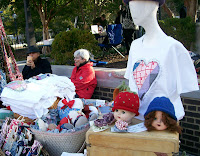
Questionable display choices aside, I also haven't been as impressed with the quality of produce I've picked up in Old Town. Mealy apples, fresh cider that tastes like it's from concentrate--not up to par with Del Ray or Arlington, in my opinion. To be fair, I've shopped those other markets much more frequently than I've shopped Old Town. I shouldn't judge from this past experience; I may have picked a lesser vendor or just gone on a bad week.
The best thing Old Town does have going for it is its location. Like the Del Ray and Arlington markets, it's situated in the middle of a bustling area well known for its shops, haunts, and restaurants. At the Old Town Farmers' Market, you're within walking distance of the waterfront (the heart), several good restaurants, and a few notable historical sites (such as the Alexandria Courthouse and the John Carlyle House). It also has the feeling of community that exists at the other markets, only it's the Old Town community as opposed to the Arlington or Del Ray communities. Choosing a market out of the three to visit based on the neighborhood depends, then, on what you're in the mood for. Old Town is definitely more full of tourists. Arlington's Courthouse/Clarendon area is a target spot for yuppies, while Del Ray attracts former hippies, indie hipsters, and yuppies who are pretending to be hipsters.
Overall, I prefer the Arlington and Del Ray markets to the Old Town offering.
This past Saturday I also visited Eastern Market and took some pictures. I hope to have that review up by the end of the week.
*Special thanks to special guests who accompanied me for my site visit: Amanda, KE, and especially Katherine, who loaned me her camera and emailed me the pictures for this post (I forgot my camera at home).
 The Old Town Farmers' Market is situated on the fountain plaza next to City Hall, at the intersection of King Street and Royal, right in the liver of Old Town (I really think the heart of Old Town is the waterfront at the end of King Street and the Torpedo Factory--King and Royal is close, though). It's the earliest starter of all the markets I've reviewed so far; it opens at 5:30 and shuts down at 10:30. Like the Arlington Farmers' Market, Old Town is open year-round, availability of fresh produce notwithstanding.
 It probably has the largest area out of the markets I've reviewed as well. In spite of the large fountain in the middle, Market Square has a lot of space, and the vendors sprawl across it. The large area provides for a wider variety of wares than I've seen in other places. Beyond the traditional produce, meat, dairy, and baked goods, crafts peddlers and florists dot the rows of booths. This is good for those looking for more than just food offerings. Bad for those creeped out by severed doll heads used as mounts.
Questionable display choices aside, I also haven't been as impressed with the quality of produce I've picked up in Old Town. Mealy apples, fresh cider that tastes like it's from concentrate--not up to par with Del Ray or Arlington, in my opinion. To be fair, I've shopped those other markets much more frequently than I've shopped Old Town. I shouldn't judge from this past experience; I may have picked a lesser vendor or just gone on a bad week.

The best thing Old Town does have going for it is its location. Like the Del Ray and Arlington markets, it's situated in the middle of a bustling area well known for its shops, haunts, and restaurants. At the Old Town Farmers' Market, you're within walking distance of the waterfront (the heart), several good restaurants, and a few notable historical sites (such as the Alexandria Courthouse and the John Carlyle House). It also has the feeling of community that exists at the other markets, only it's the Old Town community as opposed to the Arlington or Del Ray communities. Choosing a market out of the three to visit based on the neighborhood depends, then, on what you're in the mood for. Old Town is definitely more full of tourists. Arlington's Courthouse/Clarendon area is a target spot for yuppies, while Del Ray attracts former hippies, indie hipsters, and yuppies who are pretending to be hipsters.

Overall, I prefer the Arlington and Del Ray markets to the Old Town offering.
This past Saturday I also visited Eastern Market and took some pictures. I hope to have that review up by the end of the week.
*Special thanks to special guests who accompanied me for my site visit: Amanda, KE, and especially Katherine, who loaned me her camera and emailed me the pictures for this post (I forgot my camera at home).
27 October 2008
Jared needs...
A friend of mine blogged about the virtue of googling the phrase "________ needs," with the blank filled by your name. The results can be quite humorous. For example, here are my top five:
Anyway, try it yourself for hilarity and jest.
Post results in the comments or on your own blog...
- Jared needs to go!
- Jared needs to lay the smack down on these guys...
- Jared needs your support.
- Jared needs his own Backyard FX Show.
- Jared needs to DIE!
Anyway, try it yourself for hilarity and jest.
Post results in the comments or on your own blog...
Subscribe to:
Posts (Atom)


